Join WHOOP today
Teardown
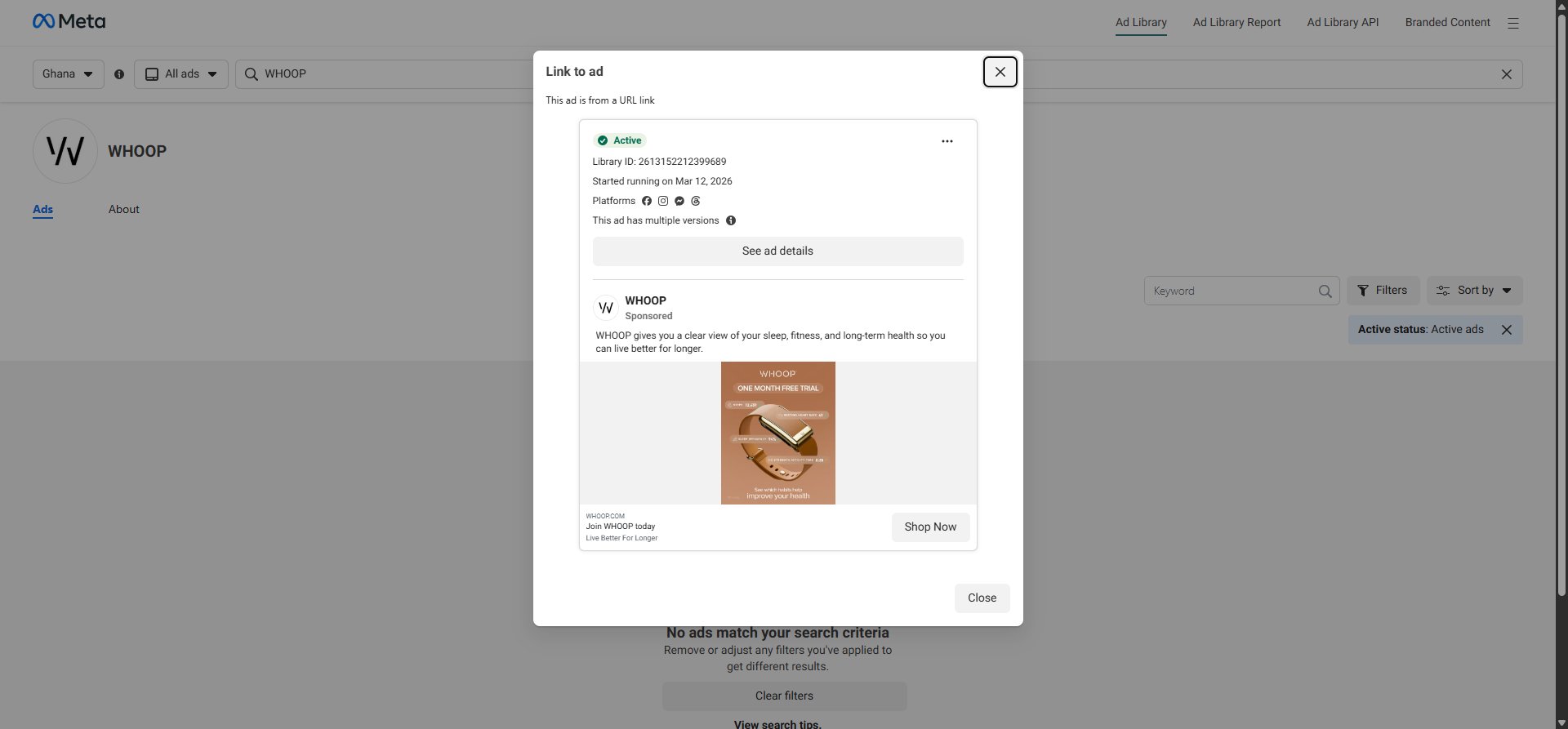
"WHOOP gives you a clear view of your sleep, fitness, and long-term health so you can live better for longer." Thirteen words of body copy. No ingredient list, no sensor specifications, no comparison table against a competing wearable. The copy reads less like product marketing and more like a doctor's prescription: you don't see how the statin works, only what it's supposed to do. That compression is strategic. WHOOP's core acquisition problem is category creation — most people who need WHOOP don't yet know a fitness membership with a tracker is a category they're shopping in. The copy skips that problem entirely by describing the outcome state: clarity, longevity, living better for longer.
The "One Month Free Trial" offer sits at the structural centre of the creative. WHOOP's pricing model is a membership — you don't buy the hardware outright, you subscribe and the hardware ships as part of the membership. That pricing structure creates a meaningful friction barrier at the point of first awareness. Offering one month free converts the acquisition ask from "buy a subscription you've never tried" to "start for free and evaluate before committing." The offer exists to absorb the trust deficit of a $30/month commitment from a cold audience seeing the brand for the first time.
The visual is the device on a wrist — the most literal possible execution of a wearable product shot. It does not try to show a athlete mid-workout or a graph of recovery scores. It shows the object. This is a deliberate restraint: WHOOP's creative research has consistently shown that product-centric visuals outperform lifestyle creative in cold traffic. The wearable form factor is unusual enough (no face, no display, no clock) that showing what it actually looks like resolves confusion before it begins.
"Live Better For Longer" as the link description is notable for what it doesn't say. It doesn't name a feature, a health metric, or a data type WHOOP tracks. "Longer" is the longevity claim — the suggestion that this device isn't for this weekend's race, it's for the decades ahead. WHOOP acquired a meaningful research library on sleep, recovery, and all-cause mortality around the time of this campaign. That research gives "longer" weight that a pure product brand couldn't earn. The ad doesn't cite the research because it doesn't need to — the brand reputation carries the implication forward. The audience who clicks "Shop Now" on a $30/month wellness membership is already in the market for exactly that kind of longitudinal value proposition.