HSA/FSA Eligible.
Your HSA/FSA money deserves better than sitting around. Put it toward a TUSHY bidet and treat your rear to a seriously cleaner routine! 2.5 million+ butts love TUSHY 100,000+ 5-star reviews Save $471/year on toilet paper Fits 95% of toilets Easy 8.5-minute DIY install
Shop NowTeardown
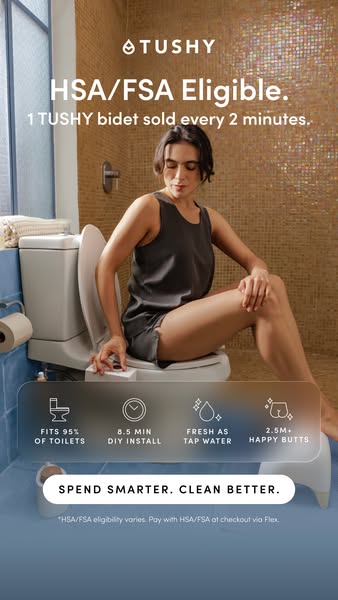
Tushy's HSA/FSA creative opens with a financial reframe rather than a product claim: "HSA/FSA Eligible." — three words in large display type at the top of the creative — is not a feature announcement. It is a purchase-friction eliminator. The moment a prospect registers that their Health Savings Account will cover this product, the bidet stops competing against discretionary DTC goods and starts competing against pre-tax dollars they are already holding. That is a different decision context entirely. Tushy is not persuading someone to spend money; it is informing them that they already have money earmarked for this.
The creative is a portrait-format lifestyle image: a woman in casual clothing, seated comfortably on a toilet, against a warm terracotta-tiled bathroom. Nothing in the image signals comedy or embarrassment. Tushy's earlier advertising leaned hard on bathroom humor — it helped them break into cultural awareness. This creative is composed like a beauty or wellness product shot: warm-toned, soft-lit, a subject who looks at ease rather than theatrical. Directly beneath the headline, in smaller type: "1 TUSHY bidet sold every 2 minutes." That social-proof figure is doing specific work. It answers the unstated objection — is this a real product that real people actually buy? — without a review count or press endorsement. Sales velocity is a proof format that implies both popularity and reliability simultaneously.
The bottom third of the creative runs a row of four feature pictograms: "FITS 95% OF TOILETS," "8.5 MIN DIY INSTALL," "FRESH AS TAP WATER," "2.5M+ HAPPY BUTTS." This is product specification presented as iconography — the visual register of an installation manual, not a lifestyle brand. The tagline beneath the icons, "SPEND SMARTER. CLEAN BETTER.", closes the loop: the first clause anchors the financial frame from the headline; the second delivers the functional outcome. There is no urgency language anywhere in the creative. No countdown, no inventory signal, no limited-edition qualifier.
The post copy runs a clean separation between creative and copy block. The creative carries one message: this is HSA/FSA eligible. The body copy then stacks six distinct proof points in bullet format — 2.5 million users, 100,000+ reviews, $471/year saved on toilet paper, 95% toilet compatibility, 8.5-minute installation, and the core product promise. The emoji deployed against each bullet — one per line — functions as visual chunking, not decoration. Each marks a different category of claim: social proof, financial savings, technical compatibility, installation friction. The sequence addresses objections in descending order of purchase-block severity: the top two lines (2.5M users, 100K reviews) handle the trust gap; the middle two ($471/year, 95% fit) handle value and compatibility; the final line (8.5-minute install) handles effort.
The ad runs across all four Meta surfaces — Facebook, Instagram, Messenger, Threads — with variants sharing the same library cluster. The HSA/FSA angle is not evergreen positioning: Health Savings Account and Flexible Spending Account accounts have enrollment windows, and FSA accounts carry a use-it-or-lose-it deadline structure that generates a distinct spending-urgency pulse in late Q4 and again in early Q1. Running this creative from March 2026 targets the post-enrollment window, when accounts are loaded and consumers are looking for eligible purchases before the deadline clock starts. The product — a bidet attachment — is HSA-eligible under IRS Publication 502 as a medical device, but this eligibility is routinely unknown to consumers. Tushy is not reminding people of a benefit they already know; it is surfacing one they did not know they had. That distinction determines whether this is a standard promotional ad or a category-education play. It is both, executed in a single creative.
The "Shop Now" CTA carries no urgency modifier — no "Today Only," no "Limited Stock." This is consistent with a healthcare-adjacent purchase register: the buyer is making a considered decision, not reacting to a countdown. At Tushy's $79–$149 price point, the effective out-of-pocket cost via HSA reimbursement approaches zero, which removes sticker-price friction as the primary objection. Tushy's structural advantage here is not the bidet — it is knowing that a competitor brand charging the same amount will not run the HSA/FSA angle until Tushy has already captured the consideration pool. That is the coherence that maintains placement across a crowded home-goods vertical: the creative does not need to win on product; it wins on information asymmetry.