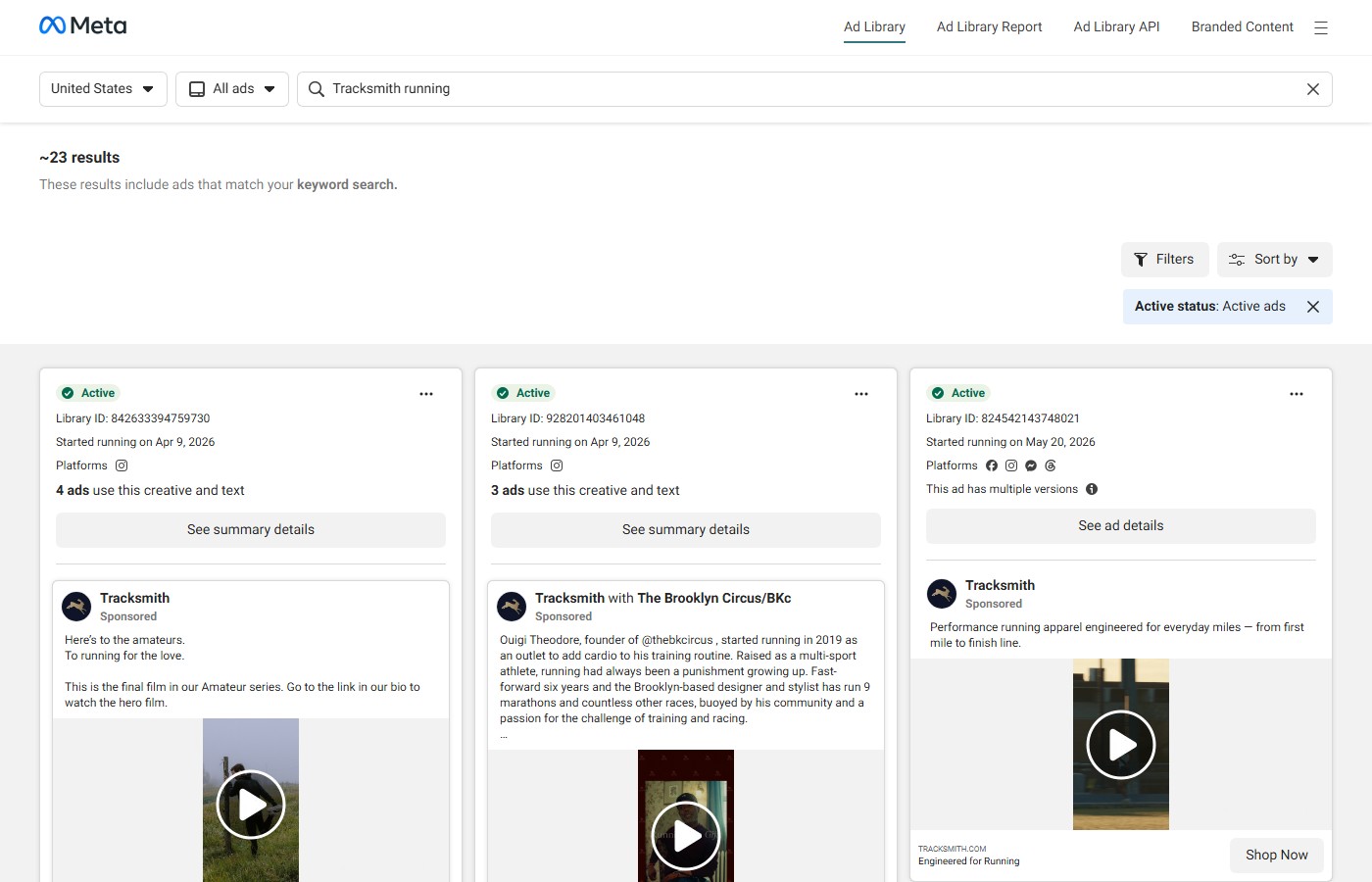
Here's to the amateurs. To running for the love.
Teardown
"Here's to the amateurs. To running for the love." Tracksmith opens by reclaiming a word the sports industry has used as a pejorative. "Amateur" derives from the French "aimer" — to love — and originally described someone who pursues an activity for the love of it rather than money. In modern usage, it has drifted to mean inexpert or insufficient. Tracksmith's ad reverses that drift deliberately: to be an amateur is to run because you can't not. It is a more honest credential than a podium finish.
This is counter-positioning executed through vocabulary rather than feature comparison. Tracksmith does not mention pace, race times, or wattage. It does not compare its fabrics against Lululemon's Silverescent or Nike's Dri-FIT. The ad doesn't even describe a product. It describes a type of person — specifically, the type of person who is not being served well by brands that talk only to elites. Every major athletic brand markets upward, to aspirational performance metrics. Tracksmith markets inward, to the relationship you have with running when no one is watching your Strava.
The word "love" is doing heavy lifting that the rest of the running category has largely abandoned. Love implies non-transactional commitment. You don't love a marathon because it improves your cardiovascular health; you love it because it reorganizes your sense of what you can do. Tracksmith is selling apparel, but the ad is selling permission — permission to be serious about something without being professional at it.
The strategic context matters here. Tracksmith launched in 2014, positioning itself as a heritage running brand with a New England training-ground aesthetic (its look references 1960s–70s collegiate running culture). Its price points are premium — comparable to Lululemon — but the brand ethos is strictly non-athletic-industrial. By leading with "amateurs," the ad does two things: it qualifies buyers (people who run recreationally and care about craft over podiums) and it disqualifies buyers who need performance data to justify premium pricing. The self-selection is intentional. Tracksmith doesn't want customers who will defect to Hoka the moment a faster-looking shoe appears. It wants customers who understand what the brand is about, which is the most sustainable DTC acquisition model there is.
The CTA "Shop Now" is the only transactional element. The rest of the ad is entirely brand-building — a toast to a community of people the brand loves. That ratio (90% ethos / 10% conversion pressure) is only viable at this spend level for a brand with high repeat purchase rates and strong word-of-mouth among its target demographic.