Shop Bras Starting at $29
Get the top-drawer upgrade you deserve during Thirdlove's Memorial Day sale.
Shop NowTeardown
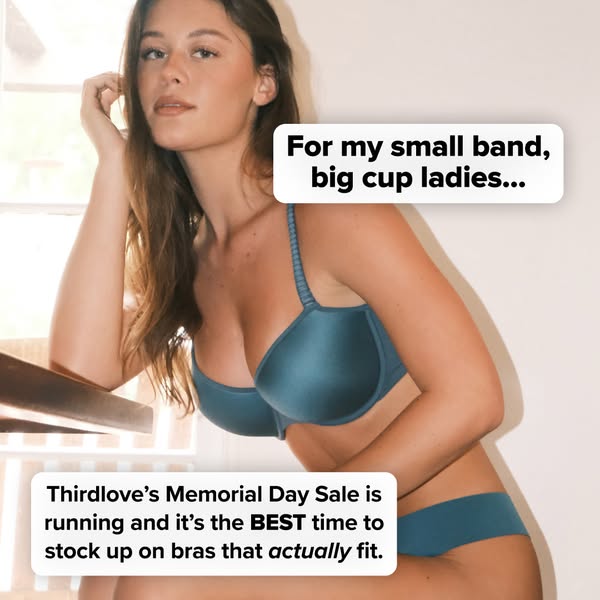
ThirdLove's Memorial Day Meta creative leads with audience exclusion before it names a product. The first text the viewer sees is a hand-lettered speech bubble dropped over a steel-blue bra: "For my small band, big cup ladies..." — an incomplete sentence, deliberately. The ellipsis functions as a filter: it acknowledges a specific fit problem — the narrow-band, large-cup body type that standard lingerie sizing has historically underserved — and signals that the remainder of this ad was built for that viewer, not for the general addressable market. The body copy "Get the top-drawer upgrade you deserve during Thirdlove's Memorial Day sale" does not appear until after that self-selection has occurred. That sequencing is not incidental. It inverts the standard DTC acquisition pattern — product first, audience second — and runs a different funnel logic: community recognition before commercial pitch.
The image is a 600×600 square: a model with dark brown hair in a relaxed pose, wearing the bra in a slate-steel colorway against a warm window-lit background. The production register sits deliberately between editorial and commercial — natural light, no studio artifice, the model's gaze slightly off-camera. The second overlay at the bottom of the frame escalates the persuasion register: "Thirdlove's Memorial Day Sale is running and it's the BEST time to stock up on bras that *actually* fit." The typographic choices — bold on BEST, italic on *actually* — read as conversational emphasis rather than promotional urgency, mimicking how a recommendation would be underlined in a text message from someone who knows the product. Text-overlay-on-editorial-photo is one of ThirdLove's recurring creative formats across their Meta library; the square crop places it natively in Instagram and Facebook feeds without requiring placement-specific creative variants.
The link card handles the rational argument without contaminating the creative tone: "Shop Bras Starting at $29." Price information in the card slot, not in the overlay or body copy, is the correct structural choice here. Running the $29 anchor in the image overlay would shift the register from "bras that fit your body" to "discounted bras" — a brand-positioning dilution for a company whose market position depends on the idea that most bras are manufactured to the wrong size map. The CTA is "Shop Now" with no urgency modifier, consistent with ThirdLove's standard link card pattern across their active Meta library.
The absence of any Fit Finder mention is the most informative creative omission. ThirdLove's Fit Finder quiz — which routes customers through cup, band, and body shape questions to surface a recommended size from a 60+ size range — is the primary conversion tool for cold traffic. A viewer who does not know ThirdLove needs the quiz to understand why the product is different from a standard lingerie brand. This ad omits it entirely. The pain-point opener presumes the viewer already understands they have a fit problem and has some prior awareness of ThirdLove's sizing approach. Cold-audience acquisition copy would lead with "Find your perfect fit" and route to the quiz; this creative leads with sale pricing and routes to a shop page. That is warm-audience conversion logic: the viewer has seen the brand, understands the product, and needs a price-urgency reason to complete the purchase now rather than later.
Three ads using this creative and text combination across five platforms — Facebook, Instagram, Messenger, Threads, and WhatsApp — from a single image asset signals a budget posture consistent with a mid-funnel retargeting pool rather than a broad cold-acquisition push. The variable being tested across the three variants is not creative direction; it is audience cluster or bid strategy. ThirdLove's structural bet in this campaign is that the conversion barrier for warm-audience visitors is price hesitation during a defined sale window, not product understanding. The job of the ad is to close that window before the consideration period expires.