The secret to glass skin? It's been in Japan for centuries.
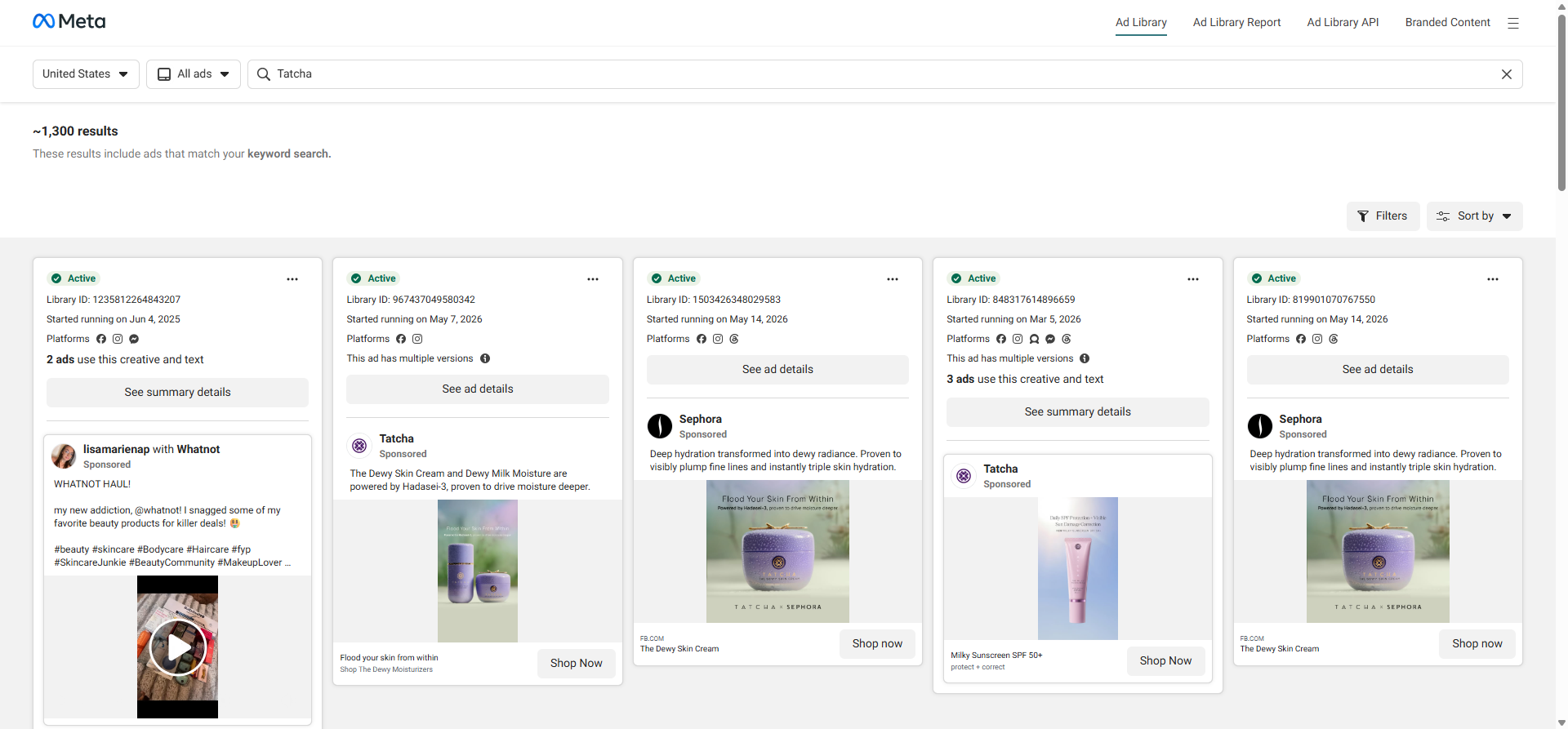
Tatcha's Dewy Skin Duo combines The Dewy Skin Cream and The Water Cream — two of our bestselling formulas powered by hadasei-3, a Japanese beauty trinity of green tea, rice, and algae. Start glowing.
Shop NowTeardown
Tatcha opens with an ancient-secret frame — "The secret to glass skin? It's been in Japan for centuries" — that performs two functions simultaneously. First, it positions the brand against the contemporary DTC skincare default of clinical innovation, lab-developed compounds, and peer-reviewed efficacy data. Tatcha is not claiming it discovered something new; it is claiming the discovery happened centuries ago and Western skincare has simply been slow to adopt it. That framing is brand-differentiating because it makes the scientific establishment the laggard, not Tatcha. Second, the rhetorical question structure ("The secret to glass skin?") treats "glass skin" as a known desire — the viewer is assumed to already want dewy, luminous skin and is receiving an answer to a question they have implicitly been asking. This is correct targeting: by the time a Meta user has been served a Tatcha ad, their algorithmic signal likely includes beauty editorial browsing where "glass skin" appears constantly.
"Hadasei-3, a Japanese beauty trinity of green tea, rice, and algae" is an ingredient claim built for discoverability rather than chemistry. The word "trinity" is doing theological work — it implies a sacred, intentional combination rather than a formulation decision. Green tea, rice, and algae are all recognizable plant ingredients that the target consumer (premium skincare buyer, ingredient-literate) can evaluate independently. None requires a chemistry degree to process as credible. The choice to name the proprietary complex (hadasei-3) rather than lead with just the ingredient list gives Tatcha a branded shorthand that accumulates equity across multiple touchpoints: once the buyer knows what hadasei-3 is, every subsequent ad that mentions it functions as retargeting even without product imagery.
The "Start glowing" CTA is understated for a reason. Tatcha's brand voice is considered and quieter than most DTC skincare. The copy avoids superlatives ("best," "most effective," "revolutionary") that have been inflated into meaninglessness across the category. "Start glowing" makes a promise that is specific enough to be checkable after use and modest enough to be believable before it. It also implies a journey — glowing is a state you move toward, not a switch that flips — which supports the subscription dynamic implicit in any skincare routine.
The Dewy Skin Duo bundling strategy reflects Tatcha's LTV architecture. Rather than converting a single hero product (The Water Cream alone), the brand uses the Duo to establish a two-step routine that locks the buyer into a two-SKU replenishment cycle. The duo format also increases AOV on the first order, making the acquisition economics work even with the category's high creative spend requirements. Tatcha's Meta creative tends to run at a premium CPM given the audience concentration in luxury beauty segments; the higher AOV justifies the bid.
The visual language — minimal Japanese-influenced product photography, soft warm light, negative space — is calibrated to stand apart from the maximalist, color-saturated product shots common in mass DTC skincare. The aesthetic signals luxury tier positioning before the price point is revealed, which reduces price resistance among buyers who interpret visual restraint as a signal of quality.