Clinically studied to reduce bloating in 7 days. DS-01 Daily Synbiotic.
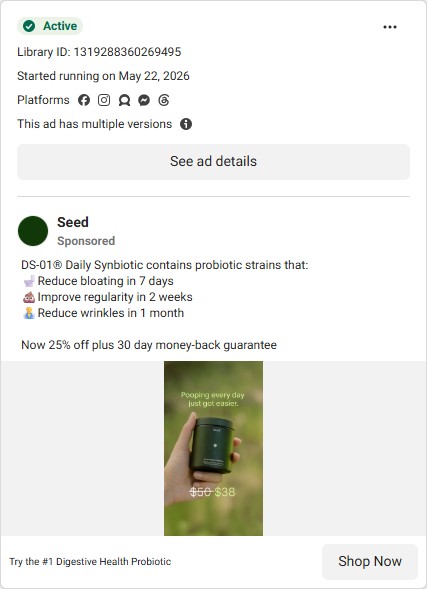
DS-01 Daily Synbiotic. Clinically studied to reduce bloating in 7 days, support regularity, and improve skin clarity. 25% off your first month.
Shop NowTeardown
Seed's DS-01 ad demonstrates the specificity-as-credibility strategy at its most compressed. "Clinically studied to reduce bloating in 7 days" is doing several things simultaneously: it names the outcome (bloating reduction), provides a timeframe (7 days), and establishes an evidence tier (clinically studied) that stops short of the FTC's "clinically proven" threshold while importing most of its persuasive weight. The distinction is legally meaningful — "studied" implies research was conducted without asserting the research was conclusive — but for a consumer reading a three-second ad unit, the operational difference between "studied" and "proven" is negligible. Seed has threaded a needle between regulatory compliance and persuasive impact.
The probiotic and synbiotic category is crowded with brands making vague wellness claims ("supports gut health," "promotes balance") that provide no anchor for the consumer's evaluation. Seed's approach is to compete on specificity: a timeframe, an outcome, a mechanism. The DS-01 formulation includes both probiotics and prebiotics (hence "synbiotic") and Seed invests substantially in publishing clinical research that supports its specific strain combination. That investment in science infrastructure is what makes the "clinically studied" claim defensible and is also what differentiates the brand from the capsule-and-print-a-claim competitors that populate the supplement aisle.
Bloating is the most acutely felt gut symptom among the target consumer base — it is visible, uncomfortable, and socially salient in a way that more abstract microbiome claims are not. Leading with bloating rather than gut health in general is a pain-point prioritization decision: the headline addresses the problem the viewer is most likely to be experiencing right now rather than the systemic benefit that requires a longer explanation to understand. Skin clarity and regularity are supporting claims that appear lower in the copy hierarchy, which reflects their secondary importance in the initial conversion argument.
The 25% first-month discount follows the subscription acquisition playbook common to the supplement category. Seed sells on a subscription basis, and the unit economics of probiotic supplements — high manufacturing cost relative to COGS, but high customer lifetime value for retained subscribers — justify a discounted acquisition offer. The 25% figure is a meaningful reduction on a subscription that retails above $40/month, and it positions the first-month price within the impulse range for health-motivated consumers.
The static image format is appropriate here because the product argument is essentially pharmaceutical in structure: the evidence is in the words, not in the visuals. Unlike a food or skincare product where showing the texture or application is part of the argument, a probiotic capsule is a credence good — its benefits are invisible at the point of purchase. Seed leans into that credence structure by making the claim language as specific and evidence-anchored as the format will support, trusting that consumers who are already in the market for a gut health product will respond to a well-supported outcome claim faster than to a lifestyle image.