Twist Ring
Teardown
Mejuri's Meta creative turns the jewelry category's oldest assumption — that fine pieces belong to occasions — into an advertising lever. "Make fine jewelry an everyday occasion." is a positioning statement compressed into a seven-word brief. The implicit argument: the ring doesn't need a reason. In a category still largely funded by engagement and anniversary gifting cycles, that compression lands with more precision than another self-care headline would.
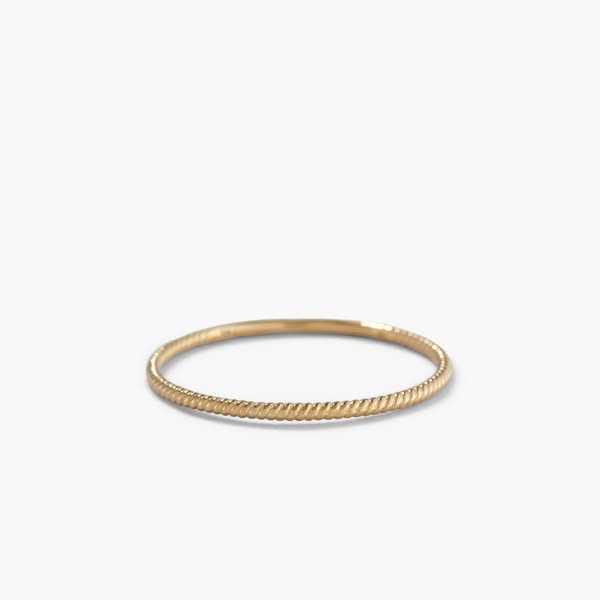
The product shot does work the copy doesn't attempt. No hand model, no wrist context, no ambient styling — just the Twist Ring against a neutral gray background at 600×600, centered, with enough directional shadow to confirm depth without dramatizing it. Jewelry brands default to hand models because scale and wearability are real purchase barriers. Mejuri's refusal to include one is a signal about its customer: someone who has bought fine jewelry before and doesn't need orientation cues to make a decision. It also strips out the occasion reading that lifestyle photography would inject. A hand in a frame implies a moment; a floating ring implies a permanent possession you carry with you every day.
The headline reads "Twist Ring" with no modifier, and the CTA is "Shop Now" without any urgency qualifier — no discount callout, no scarcity signal, no inventory prompt. That compression is deliberate at this funnel stage. The search-intent audience for demi-fine gold stacking rings already knows the vocabulary; they're qualifying on product aesthetics and price point, not being introduced to the category. The absence of urgency language is a brand identity signal: the ring is worth full price this week and the week after. If the landing page breaks that composure with a countdown banner or a "limited quantities" alert, that's the point where the ad's tone and the PDP experience diverge — and where CPAs quietly climb.
Running six creative versions simultaneously on a static image placement is the right architecture for a demi-fine SKU that varies primarily by finish and texture across the catalog. Six versions let the algorithm surface which composition — straight-on, slight angle, overhead — indexes best against the self-purchase intent cluster without the production overhead of video. Static images also carry lower CPM floors on Instagram feed, where this format sits natively and where Mejuri's core 25-to-40-year-old audience over-indexes. The deliberate absence of occasion language, lifestyle context, and urgency mechanics is Mejuri's competitive moat in miniature: it maintains a consistent creative identity across a catalog that would otherwise blend into the broader DTC jewelry noise.