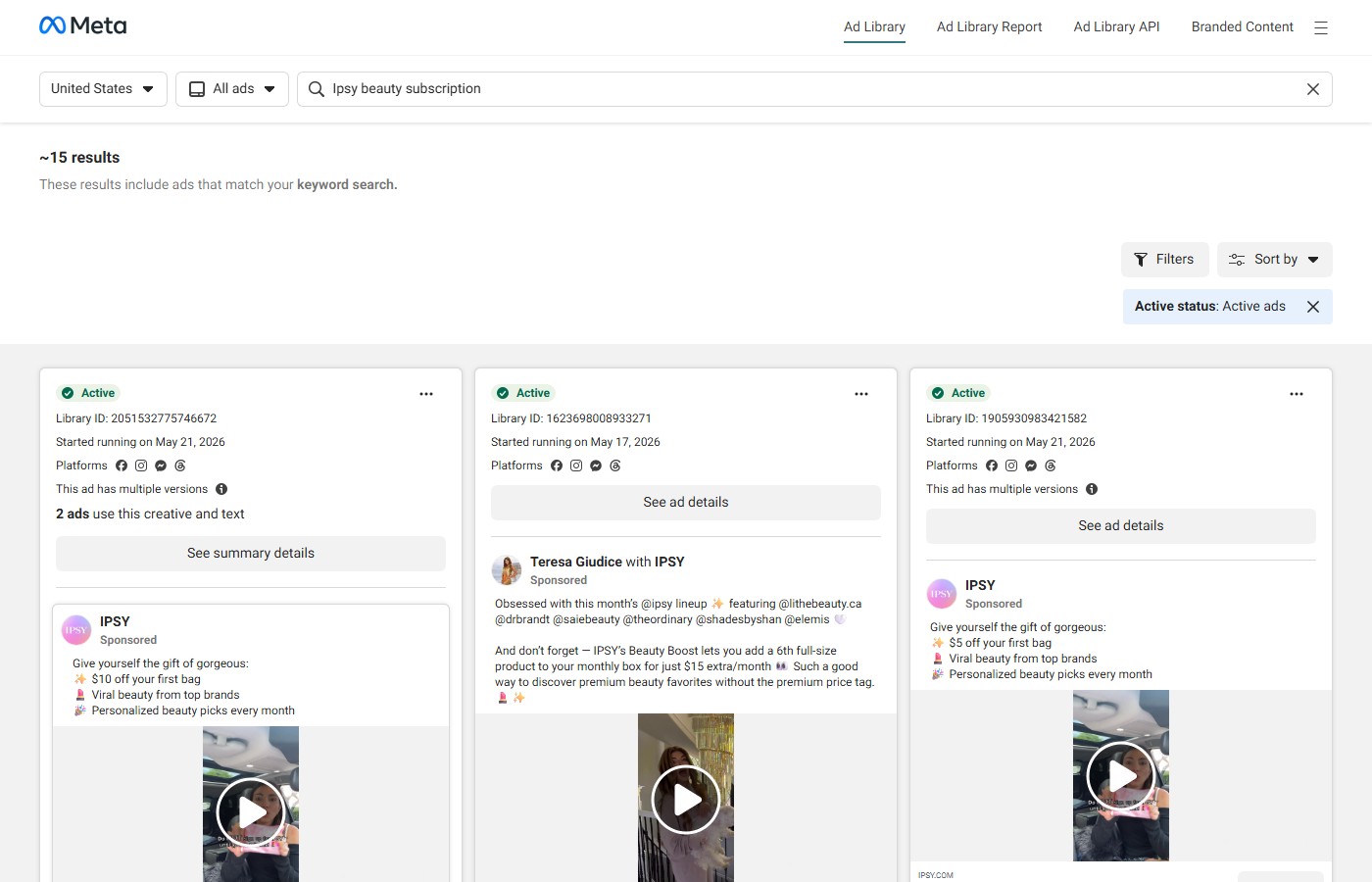
Give yourself the gift of gorgeous. $10 off your first bag.
Teardown
"Give yourself the gift of gorgeous: $10 off your first bag." IPSY's opening removes the occasion requirement from a beauty purchase. "Give yourself the gift" is a self-gifting frame that appears across beauty, wellness, and apparel advertising, but it is particularly well-suited to a subscription product. A one-time gift purchase requires a reason (a birthday, a promotion, a holiday). A subscription gift to yourself requires only the ongoing desire to look and feel good — which most of the target audience already has. The framing also removes the gift-guilt that can attach to personal spending in a category culturally coded as indulgence: if you're giving yourself a gift, you're permitted to be generous.
"Gorgeous" is doing the work that "products" would do in a weaker ad. IPSY is not selling you a Glam Bag. It is selling you a transformation — a version of yourself that is, in the brand's language, gorgeous. That aspiration is portable: it attaches to the bag and everything inside it. The word choice signals that IPSY understands its audience is buying a feeling, not a SKU.
"$10 off your first bag" is an unusually accessible entry offer for a category where subscription brands often lead with free trials, which carry high return rates and customer commitment issues. IPSY's Glam Bag starts at approximately $14/month. A $10 discount makes the first bag a $4 commitment — essentially a trial-price entry that is low enough to eliminate financial risk for any interested buyer, while still capturing payment information and subscriber intent. The $4 first month creates a behavioral investment (I've joined; I've decided; I'm an IPSY subscriber) that pure free trials do not.
The product category IPSY operates in — personalized beauty subscription boxes — addresses a structural problem in the beauty industry: discovery. The average Ulta or Sephora carries tens of thousands of SKUs. The choice architecture is overwhelming for anyone who does not have a trained beauty professional helping them navigate it. IPSY's personalization mechanic — a beauty profile quiz that captures skin type, tone, hair texture, style preferences, and product categories — narrows the selection problem to five curated items per month chosen specifically for the subscriber. The product the subscriber receives is not IPSY's choice; it is the algorithm's translation of the subscriber's stated preferences. That personalization is the subscription's core value proposition beyond the price discount.
"Get Started" as the CTA signals a longer onboarding process — the beauty profile quiz — rather than a direct cart experience. IPSY is asking the reader to invest a few minutes in self-description before receiving products. That investment is by design: the more information the subscriber provides, the more accurate the curation, and the more likely the subscriber is to receive products they love, keep the subscription, and refer friends. The quiz is simultaneously a personalization tool and a retention mechanism, and the "Get Started" CTA frames joining as beginning something, not buying something.