Full-body. Half the time.
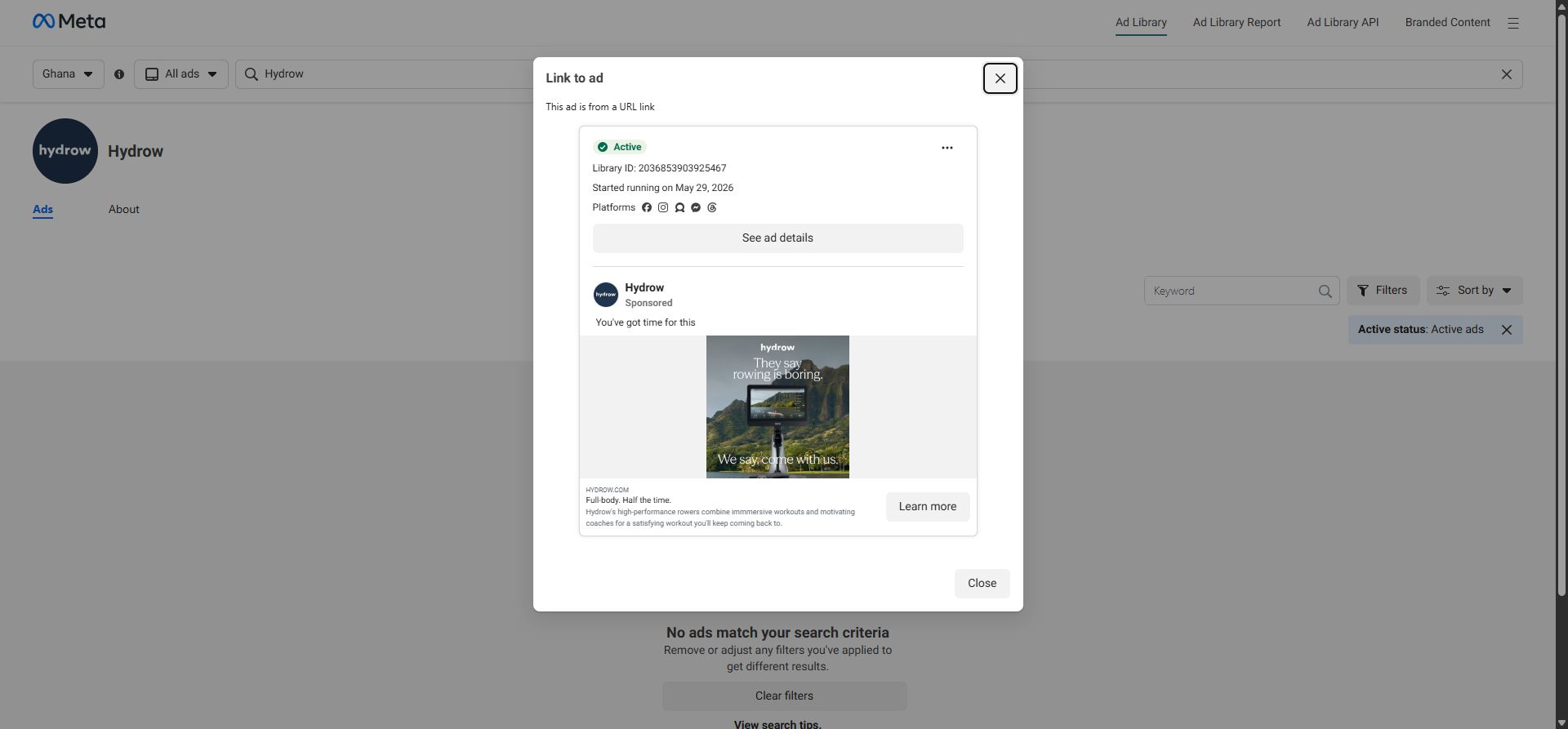
You've got time for this
Learn moreTeardown
Hydrow's May 2026 creative leads with a direct objection acknowledgment: "They say rowing is boring. We say come with us." This is an unusual creative structure for a $2,500+ home fitness machine. Most premium connected-fitness brands run aspiration-forward creative — the transformed body, the elite athlete coach, the immersive class experience. Hydrow's approach here is adversarial toward the category stigma rather than aspirational toward an outcome. The implicit argument is: the objection you have already formed ("rowing is boring") is the evidence that you haven't experienced what Hydrow is. This framing treats buyer skepticism as the creative's starting point rather than as something to be avoided.
The "We say come with us" response to "they say rowing is boring" is invitation language, not claim language. The distinction matters commercially. A claim ("rowing is not boring") invites counter-argument. An invitation ("come with us") bypasses the debate entirely and repositions the experience as something that can only be evaluated first-hand. For a product at Hydrow's price point, the buyer's risk perception is high — no one wants to be wrong about a $2,500 investment. "Come with us" reduces that risk frame by making the evaluation a shared experience rather than a solo judgment call.
"You've got time for this" is the body copy in its entirety. This is deliberate minimalism in service of a specific objection: time. The connected-fitness category's primary competitive barrier is not space (people have solved home gym space) or motivation (that's what coaches are for) — it is perceived time burden. Rowing is often associated with long, sustained cardiovascular sessions. Hydrow's ad doesn't argue against that perception directly; it simply asserts the opposite with confidence. No evidence, no qualification — just a direct counter to the time objection that the buyer is carrying.
"Full-body. Half the time." in the link card headline is the dual performance claim that completes the time argument. "Full-body" is a category-correct claim for rowing: it is genuinely one of the few cardio modalities that activates upper body, core, and lower body simultaneously. "Half the time" is the payoff of the time assertion in the body copy — it quantifies the efficiency without claiming a specific benchmark (half the time of what? the buyer fills in their own frame of reference). This is intentional vagueness deployed precisely: the buyer who currently runs 60-minute sessions reads "half the time" as 30-minute rowing sessions; the buyer who does 45-minute spin reads it as 22 minutes. The claim expands to fit each buyer's context.
The outdoor scenic imagery — mountains, landscape, natural light — is the creative's most counterintuitive choice. Hydrow is an indoor rowing machine. The brand's differentiator is immersive screen-based workouts featuring coaches rowing on real bodies of water. Using an outdoor landscape as the ad's visual anchor is not inconsistent; it is the destination argument. The buyer isn't buying a machine; they are buying the experience of feeling like they are somewhere worth being. The "come with us" language in the copy and the wilderness imagery in the creative frame the Hydrow purchase as access to those places, rendered on the machine's screen, in the buyer's home gym. That is the aspirational layer beneath the efficiency argument.
Running from May 29, Hydrow is targeting the early summer window before peak vacation season, when home gym equipment purchases historically spike as buyers try to build habits before summer schedules disrupt routines.