The Best in Bed for 12 Years and Counting
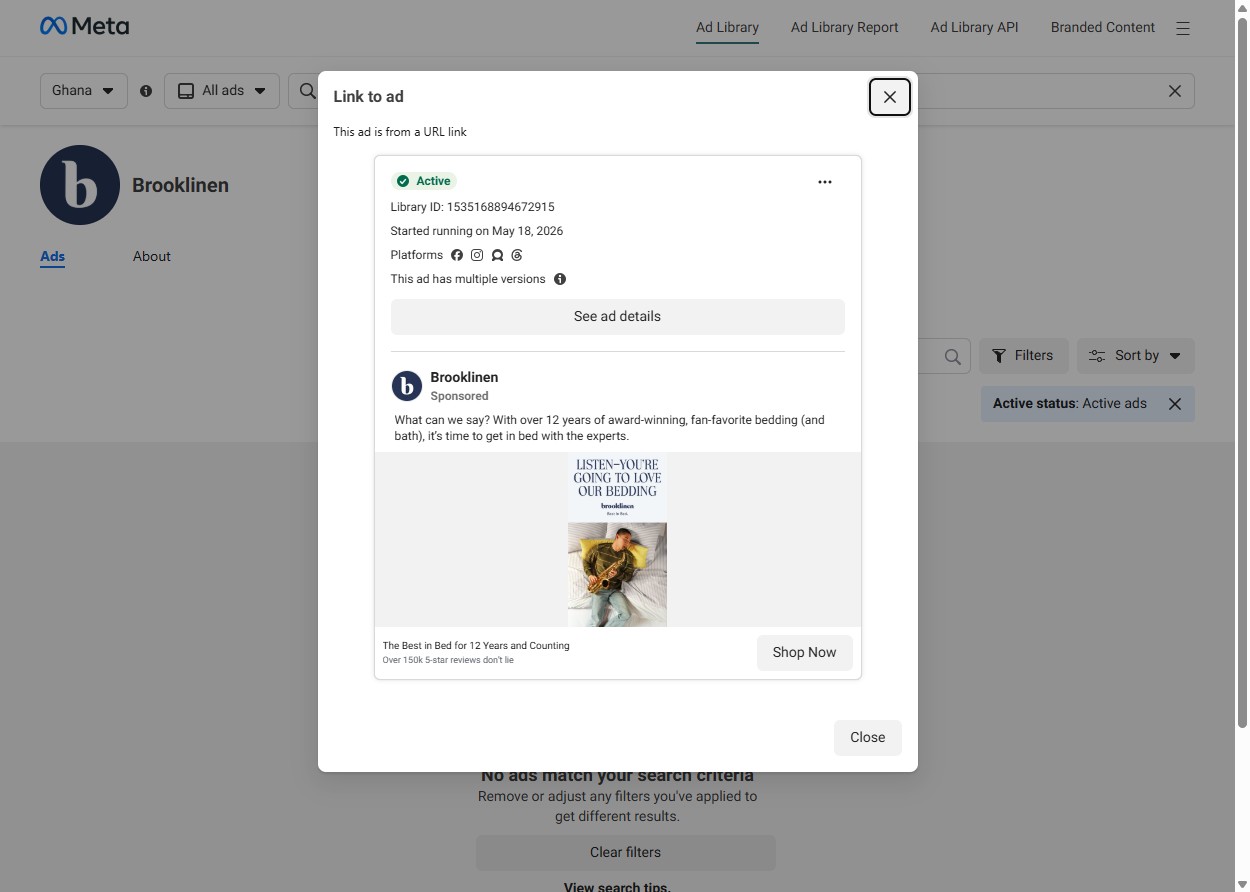
What can we say? With over 12 years of award-winning, fan-favorite bedding (and bath), it's time to get in bed with the experts.
Shop NowTeardown
Brooklinen's "LISTEN—YOU'RE GOING TO LOVE OUR BEDDING" Meta creative opens with a command, not a pitch. The image splits into two panels: the upper half is white space with large dark navy serif type making a flat assertion — "LISTEN—" pause — "YOU'RE GOING TO LOVE OUR BEDDING" — followed by the Brooklinen wordmark and its tagline "Best In Bed." below it. The lower half is a lifestyle photograph of a person in an olive green sweater lying on white sheets, eyes closed, playing a gold saxophone. There is no comfort narrative. No thread-count callout. No comparison grid. The creative commits entirely to a single posture: we already know you're going to love this, and we're telling you so before you've asked a single question.
The saxophone is the most deliberate creative choice in the frame. Bedding advertising defaults to one of three visual registers: serene white-room aspirational (luxury-hotel-at-home), couple-in-morning-light (emotional warmth), or comparison-table challenger (DTC disruptor mode). A person playing saxophone in bed fits none of those. The saxophone signals urban, expressive, solitary pleasure — the instrument of late nights and absorbed concentration, not relaxation optimization or wellness programming. Brooklinen is implicitly arguing that its product belongs in a life with more texture than "hotel quality at a fair price." The sheets are for people who do interesting things in bed, not for people who want to sleep like they're checking into a Four Seasons.
"LISTEN—" is doing specific structural work beyond getting attention. It commands the audience into the frame before saying anything about the product — the em dash after "LISTEN" forces a beat, the creative equivalent of someone stopping you in a conversation before making an obvious point. "YOU'RE GOING TO LOVE OUR BEDDING" is then stated in the future indicative, not the conditional. Not "you might love," not "customers love" — "you are going to." That grammatical construction presupposes the outcome and removes the audience's option to be skeptical before they've even seen the product. The body copy doubles down: "What can we say?" opens with a shrug, not an argument. A brand with 12 years on the market and 150,000+ five-star reviews is positioning that track record as evidence so established it barely requires stating.
The link card operates on a separate register from the image. The headline — "The Best in Bed for 12 Years and Counting" — carries the same double entendre as the "Best In Bed." tagline visible in the creative. Brooklinen has run this phrasing long enough that it reads as a brand signature rather than a one-off joke. The sub-headline "Over 150k 5-star reviews don't lie" converts the assertion in the image into a quantified social-proof anchor in the card — moving from brand posture to third-party validation inside a single ad unit. The destination URL routes to brooklinen.com root, not a sale collection or a campaign landing page, consistent with a top-funnel awareness posture rather than a direct-response conversion play.
The ad runs across Facebook, Instagram, WhatsApp, and Threads simultaneously from a single static image — four placements, one creative, no platform-specific adaptation. The multiple-versions flag in the Ad Library indicates Brooklinen is testing a variable other than the creative itself; the likely candidates are audience segment or placement configuration rather than copy variants. The structural reason the creative works is that its confidence is legible at feed-scroll speed: the large serif type and the declarative copy resolve in under a second, and the saxophone creates a half-beat of visual curiosity before the brand name makes sense of it. DTC bedding competitors typically establish authority through specification claims (long-staple cotton, OEKO-TEX certification, thread-count education). Brooklinen's 12-year review volume gives it the standing to skip that argumentative structure entirely and compete on assertion — which is a structurally different and harder-to-copy position than any spec claim.