Women's Running Ankle Socks - Charcoal - Medium - Cotton Blend - Bombas
Bombas is a comfort focused sock and apparel brand with a mission to help those in need. One purchased = one donated, always and forever.
Shop NowTeardown
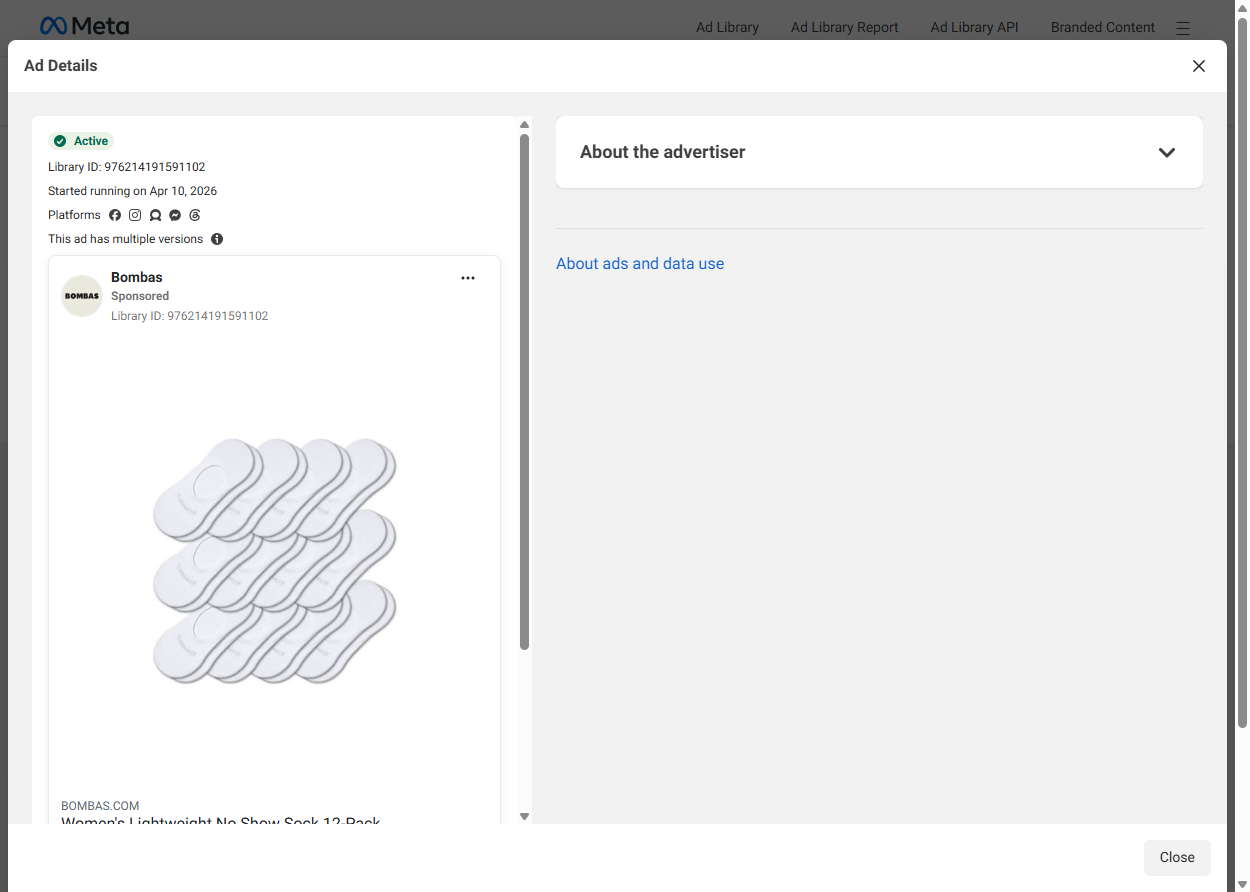
Bombas runs its entire socks and apparel catalog on Meta through a single repeating structural template: dynamic product image, product-name link card title, a fixed mission statement in the description slot, "Shop Now" CTA — and no post body copy at all. The Ad Library entry for Library ID 976214191591102 is flagged "this ad has multiple versions," confirming it's running as a dynamic catalog campaign serving different SKU variants (Women's Running Ankle Socks, Women's Lightweight No Show Sock 12-Pack, varying sizes and colorways) to audience segments shaped by browsing and purchase history. Across every variant, the product name in the link card title changes. One line does not: "Bombas is a comfort focused sock and apparel brand with a mission to help those in need. One purchased = one donated, always and forever."
The creative is an overhead product shot — a neatly arranged pile of white no-show socks on a white background. No lifestyle context, no models, no staging beyond a neutral surface. The image exists to identify the product category before the algorithm has finished rendering the link card below it, which it does in under 300 milliseconds of scroll time. The "multiple versions" structure means this clean product-photography template is being replicated across dozens of SKU variants without reshooting; only the product in frame changes. That's catalog economics: production overhead for individual ad creatives is functionally zero once the template is established. The visual decision to run socks on a white background rather than on a foot, a trail, or a gym floor is deliberate restraint — it reads as inventory photography, not aspirational lifestyle, which signals that this creative is not trying to introduce the brand. It assumes recognition.
The structural decision worth analyzing is what Bombas is doing with the link description slot. Most DTC catalog advertisers leave it empty or auto-populate it with product metadata — dimensions, materials, return policy. Bombas hardcoded a 27-word mission statement into the slot and left it there permanently. "One purchased = one donated, always and forever." The compression is doing specific rhetorical work. "Always and forever" is unusually absolute language for a brand claim — it closes the interpretive gap that "portion of proceeds" and "give-back program" language typically leaves open. By placing this line in the description slot rather than in the creative layer, Bombas avoids the production overhead of building the mission message into every image variant while ensuring it appears in every single placement, regardless of SKU. The mission statement is written once and propagates automatically across thousands of catalog ad variants.
Running mission narrative at the link-description layer rather than the creative layer also sidesteps creative fatigue dynamics. A mission-narrative video — a brand spot built around the Bombas one-for-one donation story or footage from homeless shelter partnerships — loses emotional impact with repeated impressions on the same warm audience. A 27-word text line in a description slot doesn't expire the same way. A user who has seen 40 Bombas catalog ads over two months has seen the same copy in the same position every time; the repetition reinforces rather than dulls. The choice is a direct response to the attention economics of retargeting: the mission reminder needs to stay visible without requiring creative refresh cycles to maintain effectiveness.
The ad carries no promotional offer and no social proof — no review count, no editorial mention, no cumulative donation tally. Bombas has moved over 75 million donated items since its founding in 2013, a figure that appears prominently on their homepage and in mission-forward editorial content, but it does not appear here. That omission signals audience selection: this creative is pointed at a retargeting pool that already knows the brand. For those users, restating the donation count is noise; the compressed mission reminder reactivates the moral dimension of the purchase without adding friction to the conversion path. The structural reason Bombas can run this format without any persuasion apparatus beyond a product image and a one-line mission statement is that the persuasion work has already been done upstream — by earlier editorial exposures, by prior ad impressions, by word-of-mouth. The catalog ad is the close, not the pitch.