Testing the Bold Claims of Boll & Branch
Teardown
The ad does not run from Boll & Branch's page. It runs from the New York Post's page, under the New York Post's authority, with a New York Post byline. That is the entire structural argument of the creative. Boll & Branch is not telling you their sheets are good. The New York Post is telling you — and the New York Post is telling you that it wasn't sure at first. That distinction determines every element that follows.
The primary text opens on a note of skepticism: "These sheets claim to offer chemical-free cooling and get softer with each wash." The word "claim" is doing the heaviest lift in the copy. "Claim" signals editorial distance — the kind of language a journalist uses when they haven't yet verified something. It is the opposite of a brand saying "our sheets offer chemical-free cooling," which a reader immediately discounts. "Claim" borrows the reader's own skepticism and puts it in the reviewer's mouth before the reader can articulate it themselves. By the time the body copy reaches "We tested them to see if it's bogus or if they really are the best," the reader has been cast as a co-investigator rather than a sales target.
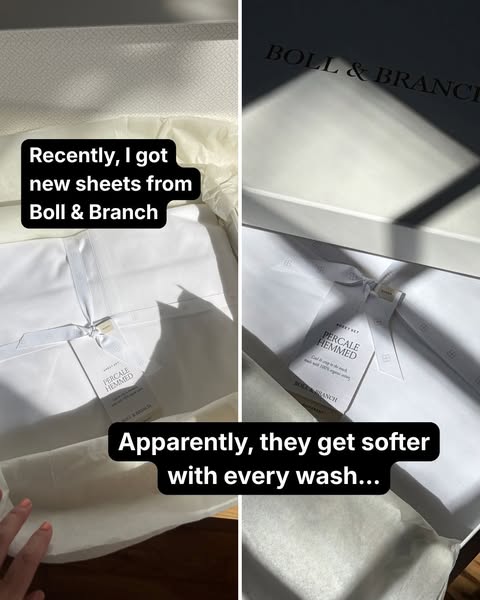
The creative is a vertical split image in native phone-shot UGC style. Left panel: a Percale Hemmed sheet set wrapped in tissue and ribbon, sitting on a surface — the kind of photo taken right after unboxing, before the packaging is even fully removed. Caption overlay: "Recently, I got new sheets from Boll & Branch." Right panel: the Boll & Branch white branded box against a darker background, the embossed brand name visible at the top. Caption: "Apparently, they get softer with every wash..." The word "apparently" mirrors "claim" from the primary text — hedged, provisional, a review-voice word rather than a marketing word. Both captions are in a sans-serif hand-applied style, legible but not polished, the kind of text someone would drop on a TikTok or Reel. The creative format does not look like a New York Post article. It looks like a friend's unboxing. That mismatch between the editorial page running the ad and the UGC aesthetic of the creative is intentional and structurally important: the institutional credibility of the NYPost page hits alongside the peer-authenticity signal of phone-shot content simultaneously.
The link card plays the two-part close. The headline reads "Testing the Bold Claims of Boll & Branch" — the NYPost article title. Below it: "B.S. or the best?" Four words that compress the entire editorial premise into a binary that a reader in a scroll cannot ignore. The construction works because it names the category of doubt a premium linen buyer actually holds. A buyer at this price point has seen enough marketing claims about thread counts and organic certifications to be legitimately uncertain. "B.S. or the best?" gives that doubt a destination. You click to resolve it rather than to be sold to.
The strategy as a whole is what the industry calls earned-media amplification — taking third-party coverage and purchasing distribution for it. What makes this execution notable is that the editorial framing is not softened for the paid context. The text still reads "bogus or really the best." Boll & Branch is betting that a review that sounds genuinely uncertain about whether their product is any good will outperform a review that sounds enthusiastic. That is a counterintuitive media buy. It works because the buyer's in-feed skepticism is not an obstacle to the click — it is the click.