Concentrated clean that really works.
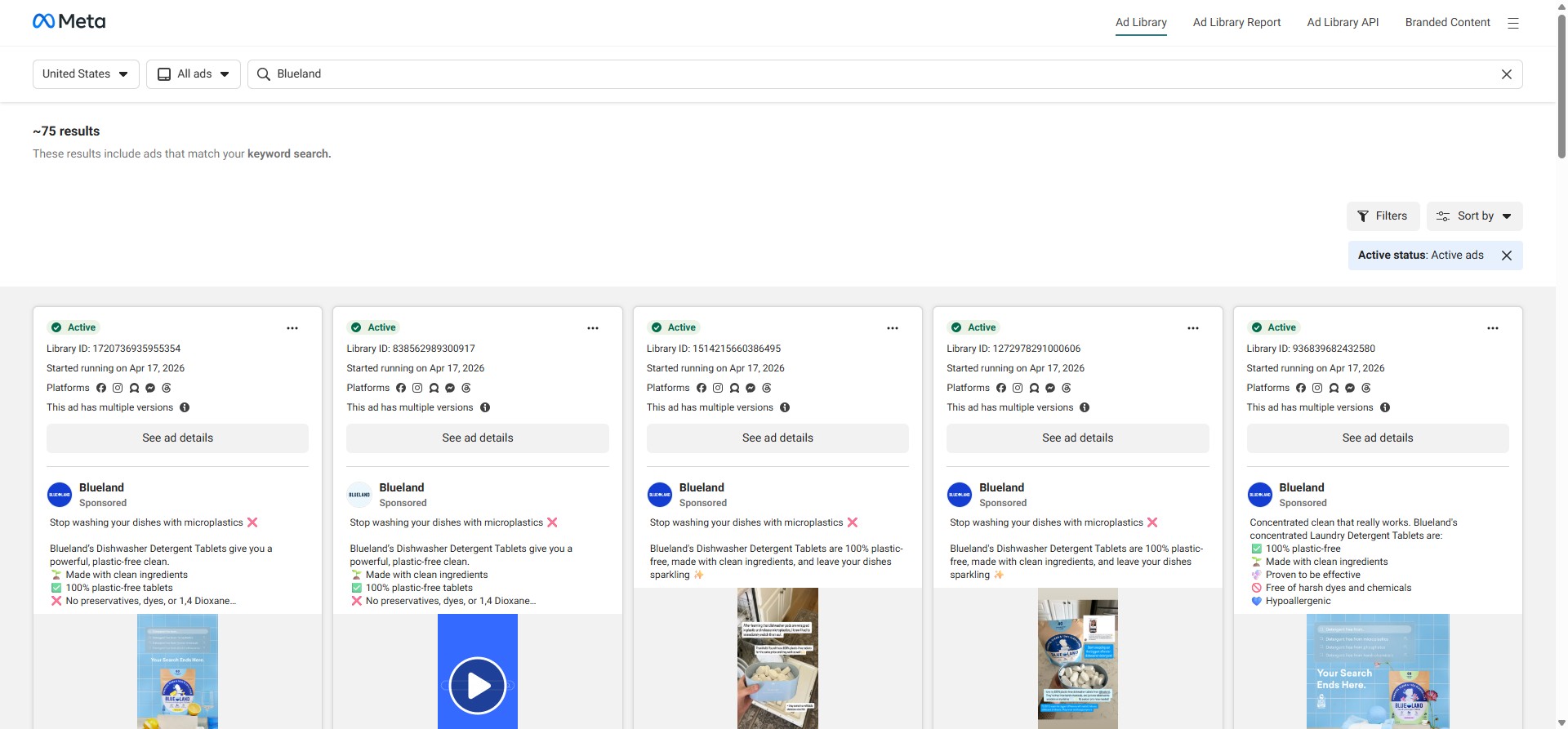
Blueland's concentrated Laundry Detergent Tablets are: 100% plastic-free. Made with clean ingredients. Proven to be effective. Free of harsh dyes and chemicals. Hypoallergenic.
Shop NowTeardown
Blueland's laundry detergent ad takes a deliberate counter-position to the brand's dominant campaign theme in the same period. While the dishwasher tab campaign leads with fear and category-crisis framing ("Stop washing your dishes with microplastics"), the laundry detergent creative leads with confidence and efficacy: "Concentrated clean that really works." The difference is instructive. By the time a consumer encounters the laundry detergent ad, they may already be aware of Blueland from the dishwasher tab campaigns. The detergent creative doesn't need to establish the problem — it needs to establish that the product is effective, which is the primary objection that sustainable cleaning brands face once consumers are interested.
"Concentrated clean that really works" is a statement of efficacy delivered without hedging. Most sustainable cleaning brand advertising layers qualifications onto performance claims: "effective yet gentle," "tough on stains and kind to the planet," "clean results without harsh chemicals." Blueland's headline makes no qualifications. It claims clean that really works, period. The word "really" is notable — it is an emphatic that functions as a pre-emptive objection response. "Really works" acknowledges that there is a skeptic in the room (the buyer who tried a natural detergent before and was disappointed) and answers the objection before it's raised.
The five-point product claim list — 100% plastic-free, made with clean ingredients, proven to be effective, free of harsh dyes and chemicals, hypoallergenic — is structured to address five distinct buyer objection categories in sequence. Plastic-free addresses the environmental conscience buyer. Clean ingredients addresses the ingredient-transparency buyer. Proven effective addresses the efficacy skeptic. Free of harsh dyes and chemicals addresses the sensitive-skin and chemical-avoidance buyer. Hypoallergenic addresses the allergy and family-with-children buyer. This is breadth-of-claim advertising designed to convert across multiple buyer segments with a single creative.
The "hypoallergenic" claim is particularly strategic for a laundry detergent product. Conventional laundry detergents are among the most common household triggers for skin reactions, allergic responses, and asthma exacerbation. Parents of young children, people with eczema, and allergy sufferers are acutely aware of detergent ingredients. For these buyers, "hypoallergenic" is not a bonus feature — it is a qualification requirement. Blueland's inclusion of this claim in the five-point list captures a need-state segment that would otherwise not consider the product.
The concentrated tablet format is the product's most significant environmental and economic innovation relative to conventional liquid detergents. Traditional liquid detergents are 60-90% water — a buyer who purchases a large liquid detergent jug is paying to transport, store, and ultimately dispose of water. Concentrated tablets eliminate the water weight entirely: the tablet dissolves in the wash, the buyer adds water at the point of use. This reduces shipping weight, packaging size, and plastic waste simultaneously. For a DTC brand, this means better margin per customer (lower shipping cost) while maintaining a higher retail price than commodity detergents through the premium positioning of the concentrated format.
The campaign running at the same time as the dishwasher tablet microplastics campaign gives Blueland cross-product presence across multiple cleaning categories simultaneously. A buyer who sees the dishwasher ad and the laundry ad in the same feed is being introduced to Blueland as a whole-home cleaning solution rather than a single-product brand. This is brand architecture advertising at the campaign level: the two ads together communicate that Blueland has replaced multiple product categories in the household, which makes the switching cost lower and the relationship with the brand more durable over time.
The concentrated tablet market is early-stage but growing rapidly, with Blueland competing against Dropps, Earthbreeze, and Tru Earth in the DTC segment. The efficacy-first positioning ("Concentrated clean that really works") directly addresses the most common reason natural cleaning brands lose to conventional detergents: the perception that they sacrifice cleaning power for environmental virtue. Blueland's creative argument is that this trade-off has been engineered away.