Bevel Trimmer
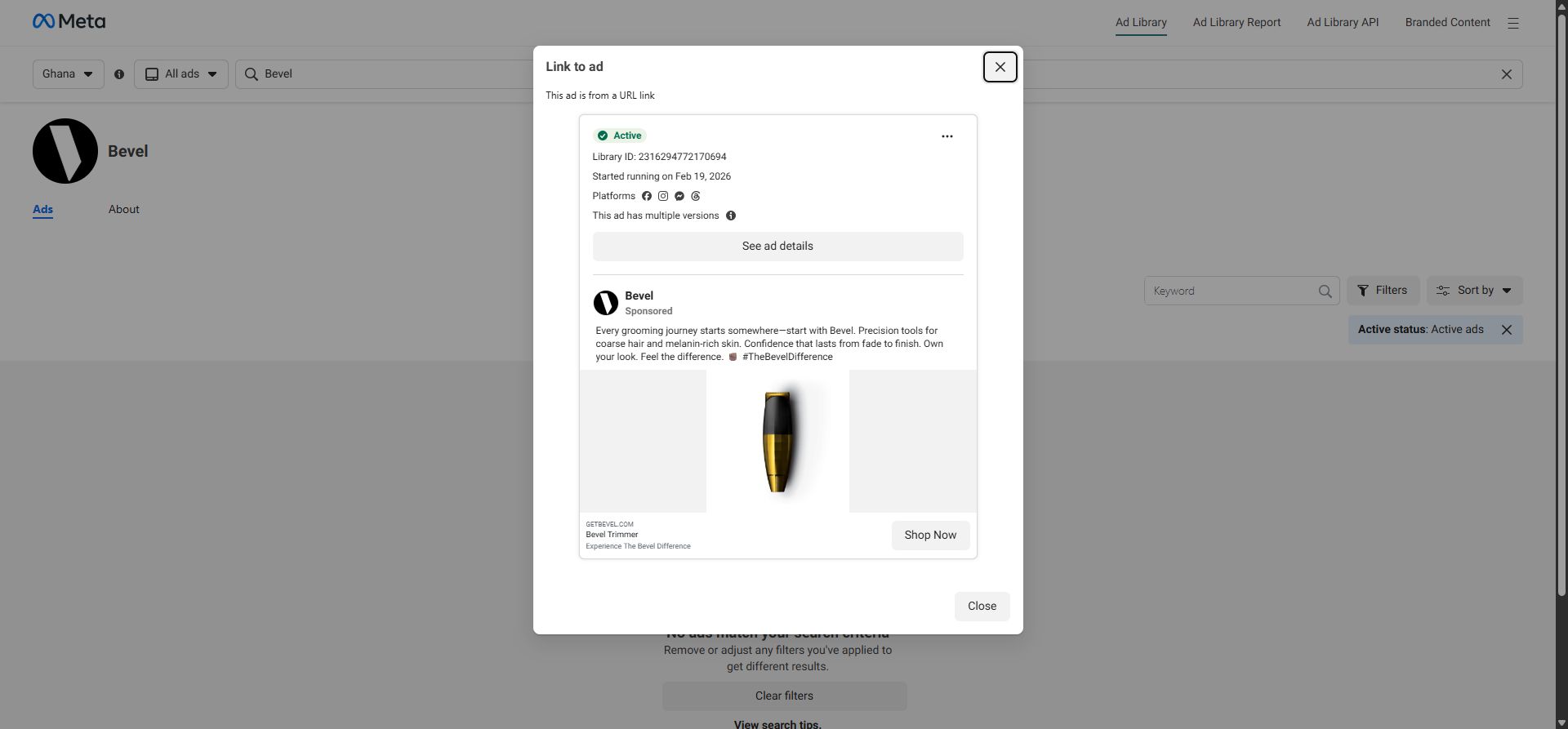
Every grooming journey starts somewhere—start with Bevel. Precision tools for coarse hair and melanin-rich skin. Confidence that lasts from fade to finish. Own your look. Feel the difference. #TheBevelDifference
Shop NowTeardown
Bevel's February 2026 trimmer creative opens with a positioning statement that is unusual in DTC advertising for its explicitness: "Precision tools for coarse hair and melanin-rich skin." Most personal care brands that target Black men do so through casting choices, color palettes, and cultural references — indirect signals that maintain plausible demographic neutrality. Bevel names its target customer directly in the copy. This is a deliberate departure from the DTC default of coded aspirational language, and it creates three effects simultaneously. First, it functions as a targeting filter at the creative level — the buyer who does not identify with "coarse hair and melanin-rich skin" self-selects out immediately. Second, it signals domain expertise: a brand that speaks this specifically about its customer has presumably built a product that accounts for those specific variables. Third, it creates community recognition — the buyer who has spent years navigating a personal care market not built for their hair and skin type reads this copy as acknowledgment, not just advertising.
"#TheBevelDifference" hashtag at the close is a community architecture move. In the DTC men's grooming category, hashtag communities have proven durable only when the brand has built enough cultural cachet to generate organic participation. Bevel's approach — using the hashtag as a copy close rather than a standalone call-to-action — integrates the community signal into the ad's argument rather than appending it as an afterthought. The implicit structure is: "Here is what we are, here is who we are for, and there is a community of people who have already made this choice." The buyer who converts is joining something, not just buying something.
"Confidence that lasts from fade to finish" is barbershop culture language applied to product advertising. "Fade" and "finish" have specific meaning in the Black grooming cultural context — a fresh fade from a skilled barber represents a particular standard of presentation, and "finish" implies the product supports the grooming outcome long after the cut. This is not generic grooming confidence language; it references the specific ritual and aesthetics of barbershop culture. Using this language signals that Bevel was built by people who understand the category from the inside.
The carousel product format — centered trimmer image flanked by empty frames — puts the tool, not the outcome, at the visual center. This is the correct choice for a brand selling to customers who already know what they want the output to look like and are evaluating whether the instrument can deliver it. Showing a fade result would tell the browser nothing they don't already know; showing the trimmer in detail signals precision engineering and invites product examination. The black and gold colorway of the trimmer anchors the premium positioning visually before the copy price-justifies anything.
The February 2026 launch timing is deliberate. Post-January, the New Year grooming refresh cycle has converted its impulse buyers. The customer Bevel acquires in February is a more considered buyer — someone who has been thinking about upgrading their tools rather than acting on a resolution. For a $40-$90 trimmer at a premium price point relative to drugstore alternatives, that considered buyer has higher LTV potential and lower return rates.