30% Off Men's Cologne Sets
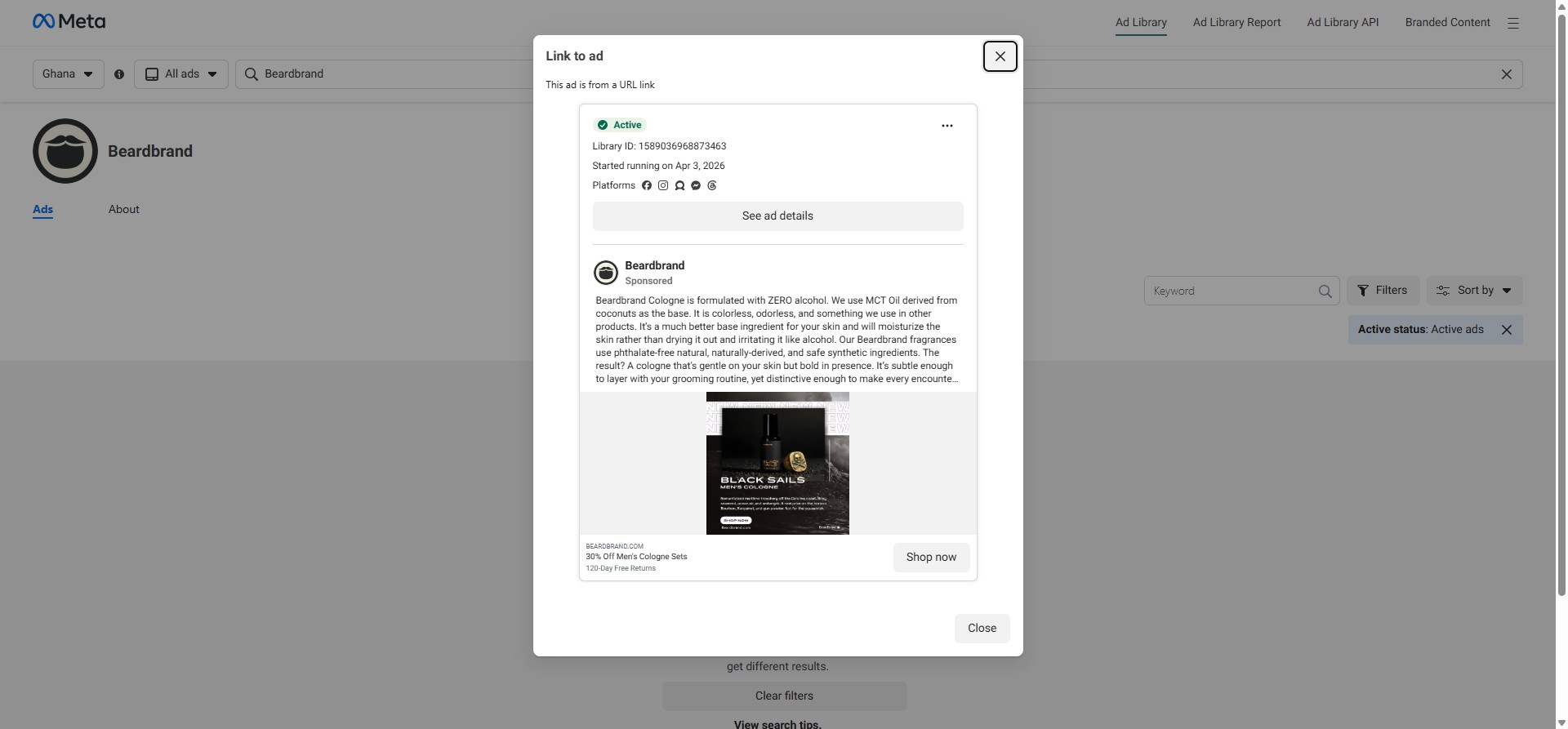
Beardbrand Cologne is formulated with ZERO alcohol. We use MCT Oil derived from coconuts as the base. It is colorless, odorless, and something we use in other products. It's a much better base ingredient for your skin and will moisturize the skin rather than drying it out and irritating it like alcohol. Our Beardbrand fragrances use phthalate-free natural, naturally-derived, and safe synthetic ingredients. The result? A cologne that's gentle on your skin but bold in presence. It's subtle enough to layer with your grooming routine, yet distinctive enough to make every encounter count. 120-Day Free Returns.
Shop nowTeardown
Beardbrand's cologne creative is a masterclass in ingredient-led education deployed at scale within a promotional frame. The headline, "30% Off Men's Cologne Sets," is a direct-offer hook that gives the scroll-stopper its urgency. But the creative's actual argument is contained entirely in the body copy, which spends roughly one hundred words explaining why MCT oil is a superior base ingredient to alcohol — a claim that does triple work. It differentiates Beardbrand from every mass-market fragrance brand at the formulation level, it educates the buyer on why the conventional category standard (alcohol) is actively bad for their skin, and it positions the product as a logical consequence of that education. The buyer who finishes the copy doesn't just know Beardbrand makes a cologne; they understand why MCT oil makes it better. That understanding converts to justified purchase rather than impulse buy, which is load-bearing for a brand with a premium price point.
The "ZERO alcohol" emphasis is doing something specific that most fragrance ads miss entirely. Cologne advertising has historically operated on abstraction — aspirational lifestyle imagery, celebrity association, abstract statements about confidence and masculinity. Beardbrand refuses all of that and substitutes ingredient specificity. MCT oil derived from coconuts is named and explained. Phthalate-free, naturally-derived, safe synthetic ingredients are listed explicitly. The visual shows the product in dark, editorial packaging (Black Sails) against a moody background, which provides the premium aesthetic signal, while the copy handles all the functional differentiation. This is a clear division of creative labor: the visual creates desire, the copy creates justification.
The "120-Day Free Returns" callout is notable because it inverts the risk calculation for a high-consideration purchase. Cologne is a sensory product that men have traditionally tried before buying. DTC brands face the fundamental problem that customers can't smell through a screen. The extended return window is Beardbrand's answer to that objection — it converts a sensory uncertainty into a reversible commitment. "Buy it, try it, return it if it doesn't work" collapses the hesitation that keeps men from purchasing fragrance online. The 120-day window (versus a typical 30-day policy) signals confidence in product quality and removes the fear of a costly mistake.
Beardbrand's audience is men who care about grooming but resist the performative masculinity of legacy fragrance marketing. The tone of the copy — technical, honest, ingredient-focused — matches that profile. The brand doesn't use "smells incredible" or "commands attention." It uses "colorless, odorless base ingredient" and "moisturize the skin rather than drying it out." This is grooming-as-craft positioning, and it attracts buyers who see fragrance as part of a systematic approach to personal care rather than a status signal.
The promotional discount anchors the ad in conversion rather than pure awareness. For a brand selling at premium price points, a 30% discount on cologne sets is a meaningful dollar-value reduction that gives fence-sitters a concrete reason to act now rather than consider later. The combination of education-led copy and time-bounded offer is an efficient funnel structure: the copy does the persuasion work that justifies the price, and the discount removes the final activation barrier. The result is an ad that feels informative rather than promotional, even though its ultimate function is to drive immediate purchase behavior.