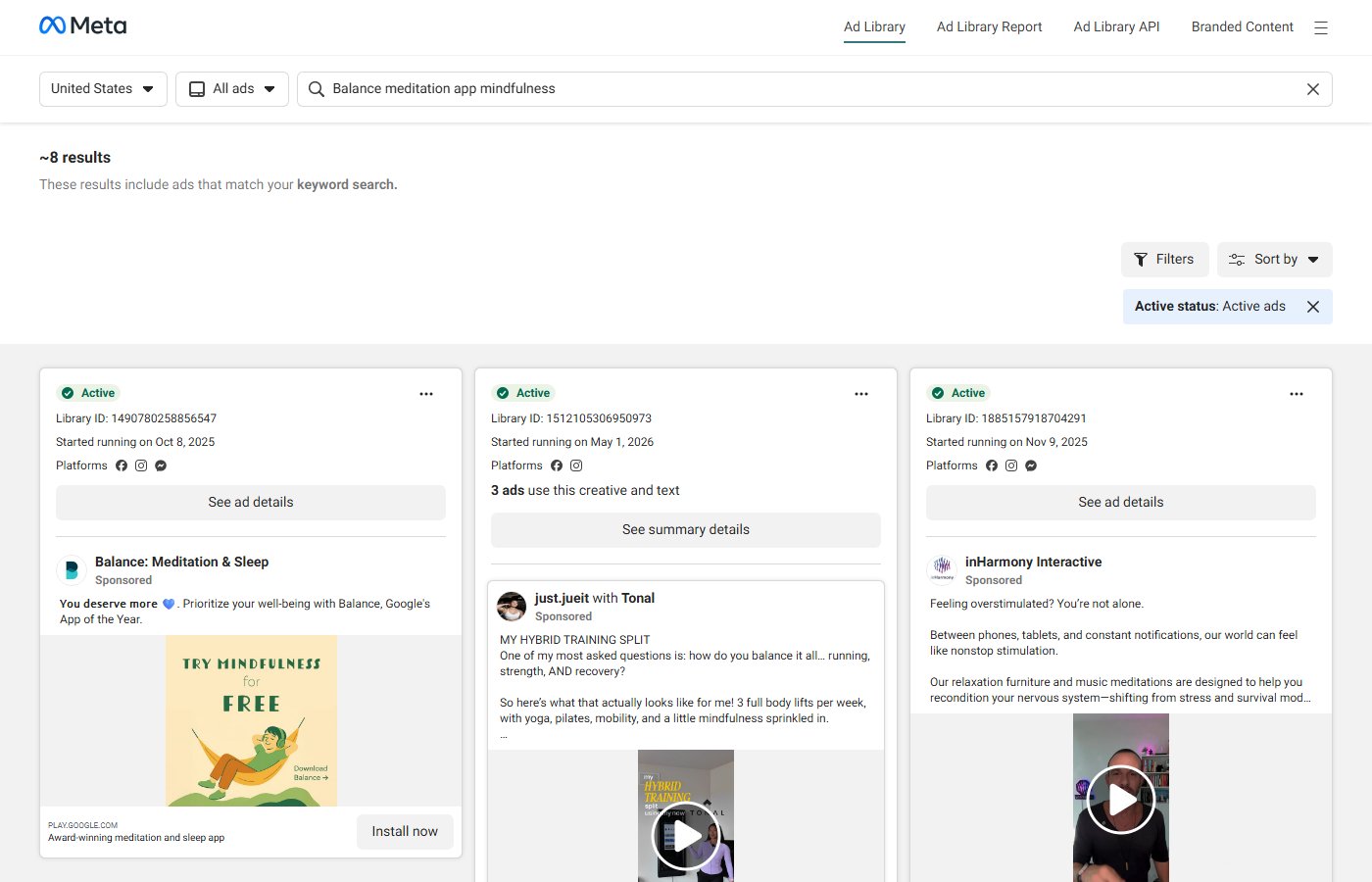
You deserve more 💙. Prioritize your well-being with Balance, Google's App of the Year.
Teardown
"You deserve more 💙. Prioritize your well-being with Balance, Google's App of the Year." This headline opens with an emotional entitlement claim and immediately grounds it in a third-party authority signal. "You deserve more" is a permission-granting hook — it addresses the psychological barrier that stops people from investing time in self-care. Many people who would benefit from a meditation app have told themselves they're too busy, that taking 10 minutes for mindfulness is indulgent, or that other priorities come first. "You deserve more" dismantles that objection before the product case is even made. It doesn't argue that meditation is effective; it removes the guilt associated with doing it.
The second clause — "Google's App of the Year" — is one of the highest-quality social proof signals available in the mobile app category. App store awards are evaluated by the platform that controls distribution, which means the endorsement comes with an implicit promise about quality, safety, and user experience. Unlike a press mention or a celebrity endorsement, a platform award is institutional and can't be purchased or faked. Balance is using this credential not just as a vanity credential but as a trust-building device for users who may have been burned by low-quality wellness apps before.
The ad creative — showing "TRY MINDFULNESS for FREE / Download Balance →" against a clean, illustrated card with a relaxed figure — is doing several things simultaneously. The illustrated style signals approachability and warmth (vs. clinical or photographic), the "for FREE" callout reduces financial friction at the moment of download, and the "Download Balance →" arrow creates a directional prompt that guides the eye toward action. The overall aesthetic is deliberately non-threatening — the Balance brand understands that people resistant to meditation need a visual invitation rather than a workout app's intensity.
"Award-winning meditation and sleep app" in the display text adds a second authority signal (award-winning) and expands the product's scope from meditation to sleep — a category with broader mainstream appeal. Many users who would never describe themselves as "interested in meditation" are actively searching for sleep solutions. By naming sleep in the display text, Balance captures intent from a different search behavior than the headline targets.
The long campaign run (started October 2025) confirms this creative is a performer. Balance has held this ad in rotation for over seven months — in a category with high creative fatigue, that longevity signals the core message continues to convert.