All depth. No drift.
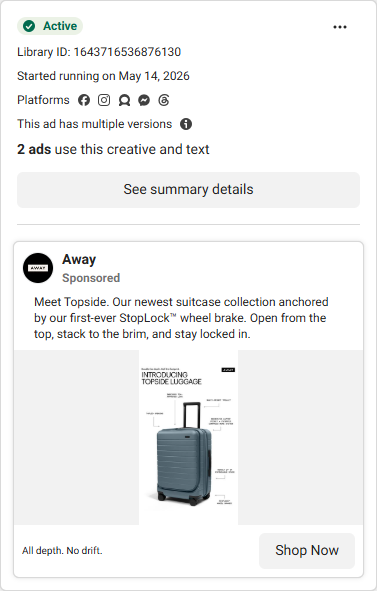
Meet Topside. Our newest suitcase collection anchored by our first-ever StopLock™ wheel brake. Open from the top, stack to the brim, and stay locked in.
Shop NowTeardown
Away's Topside launch ad makes a compression decision at the headline level that governs every other element in the creative: "All depth. No drift." Eight characters. Four words. Two product claims. "All depth" addresses the top-loading lid — the promise that you can pack deep without fighting a front-opening zipper. "No drift" addresses the StopLock™ wheel brake — the promise that the case stays where you put it when you stop at the jetway counter. The ad does not explain either feature. It names the experience each feature eliminates and leaves the prospect to complete the equation.
The creative is a static product shot on white: a full-frame view of the Topside carry-on in a muted steel-blue, with "INTRODUCING TOPSIDE LUGGAGE" printed into the creative layer as a text annotation. No airport terminal, no model, no staging beyond the product itself against a neutral ground. The visual register is not travel photography — it is product documentation, the kind a hardware company uses when announcing something engineered. Away is choosing to communicate invention rather than aspiration. A lifestyle image with the same copy would read as another travel brand ad. A white-background technical product shot with a category header printed directly into the frame reads as: pay attention to what this thing does.
The body copy sequences three distinct pieces of information without repetition. "Meet Topside." establishes the product name. "Our newest suitcase collection anchored by our first-ever StopLock™ wheel brake." anchors the collection to a single physical innovation with a registered trademark. "Open from the top, stack to the brim, and stay locked in." delivers three use-case outcomes in 11 words, each mapped directly to a feature: top-opening lid, vertical packing capacity, wheel lock mechanism. The trademark on StopLock™ is not incidental legal formality — it signals to any operator reading this ad that Away considers this mechanism a defensible competitive differentiator, not a shared feature available on any $200 carry-on at the same gate.
The ad runs across all four Meta surfaces — Facebook, Instagram, Messenger, Threads — with two variants using the same creative and copy block. This placement breadth combined with a collection-level destination (awaytravel.com/collections/topside-luggage rather than a single SKU page) is consistent with an awareness objective. A second variant in the same library cluster links directly to "Topside Carry-On in Coast Blue" at $378 and surfaces the price in the link card. This ad does not. The no-price version functions as the funnel entry: introduce the StopLock™ concept, plant the Topside name, and hold the $378 ask for retargeting pools who have already engaged with the concept. The two variants are running in parallel, not in sequence.
There is no social proof anywhere in this creative — no review count, no press endorsement, no cumulative sales figure. There is no urgency mechanism: no limited-edition qualifier, no countdown, no inventory signal. The deliberate absence of persuasion apparatus is itself a positioning decision. Away is betting that "No drift" names a real friction point specifically enough to generate awareness without social scaffolding — that the StopLock™ mechanism can carry the creative on its engineering claim alone. Whether that bet holds depends on whether "stay locked in" registers as a concrete solution to the traveler who watched their carry-on roll down the aisle on the last flight, or whether it reads as marketing language until the wheel brake is felt in person.