Go Organic
Teardown
The primary text opens mid-opposition: "Unlike synthetic foam beds, we skip the harmful chemicals and plastics." That construction — naming the category enemy before naming the self — is not a conventional ad opener. Most brand copy starts with the product or the customer. Avocado starts with what it refuses to be. The effect is immediate category isolation. A buyer reading this ad is not being asked to evaluate Avocado against other organic mattress brands. They are being asked to evaluate their current mattress — a synthetic foam bed — against a different category of object entirely. The frame is not brand versus brand. It is materials versus materials.
"Harmful chemicals and plastics" is a two-item indictment, and the specificity matters. Vague language like "toxins" or "chemicals" can be dismissed as wellness-marketing noise. Naming chemicals and plastics together creates a more concrete mental image: polyurethane foam, PBDE flame retardants, off-gassing. Buyers who have spent time researching conventional mattress manufacturing will recognize those references immediately. Buyers who have not will feel the sentence as a quiet revelation — the kind of thing they should have known. Either way, the primary text does not elaborate. It does not need to. The indictment is planted.
The closing phrase restructures the purchase logic. "Because your sleep (and the planet) deserve better." Sleep is the primary argument; the planet is the parenthetical. That sequence is deliberate. Organic-certification messaging often leads with environmental credentials, which narrows the audience to buyers who already prioritize sustainability as a purchase driver. Avocado leads with sleep — the universal entry point — and makes environmental responsibility the thing that validates a decision the buyer was already inclined to make. The parenthetical says: the self-interested choice and the ethical choice are the same choice. That is a different argument than "buy this to help the planet." It does not require the buyer to be an environmentalist. It simply tells an environmentalist that their instinct was correct.
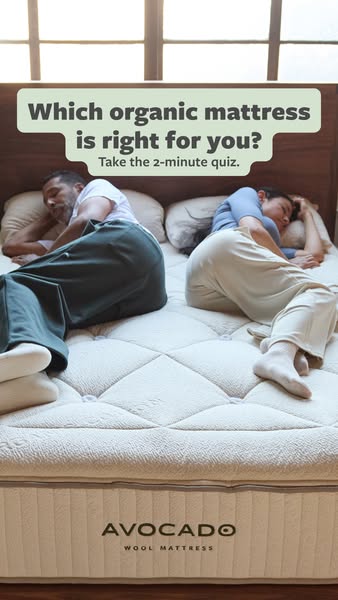
The creative is a back-to-back couple: two people sleeping in different positions on the same mattress, each undisturbed. This is the motion-isolation argument rendered visually without a word of copy. A buyer who has ever been woken by a partner can read that image in under a second. The "AVOCADO WOOL MATTRESS" branding at the bottom adds the premium materials callout: wool is a natural temperature regulator, hypoallergenic, a direct contrast to synthetic fill. The image does not state any of that. The credential lives in the product name. The visual proof lives in the undisturbed sleep positions. The creative is doing two jobs simultaneously without competing with itself.
The quiz overlay — "Which organic mattress is right for you? Take the 2-minute quiz." — converts a category-awareness ad into a lower-commitment funnel entry. This is not a buy-now ad. The link card routes to AVOCADOGREENMATTRESS.COM/MATTRESS-QUIZ. A mattress at this price point does not close on impulse. The quiz is the correct acquisition mechanism: low commitment, personalized output, a reason to exchange contact information. "Go Organic" in the link card headline compresses the brand thesis to two words. It is a lifestyle posture presented as a call to action. The buyer is not being asked to buy an Avocado mattress. They are being asked to go organic — and the quiz is the on-ramp that makes that identity shift feel like a two-minute investment rather than a $2,000 one.