Women's Wool Runner Go - Grey
The world's most comfortable shoes are made of earth-friendly materials.
Shop NowTeardown
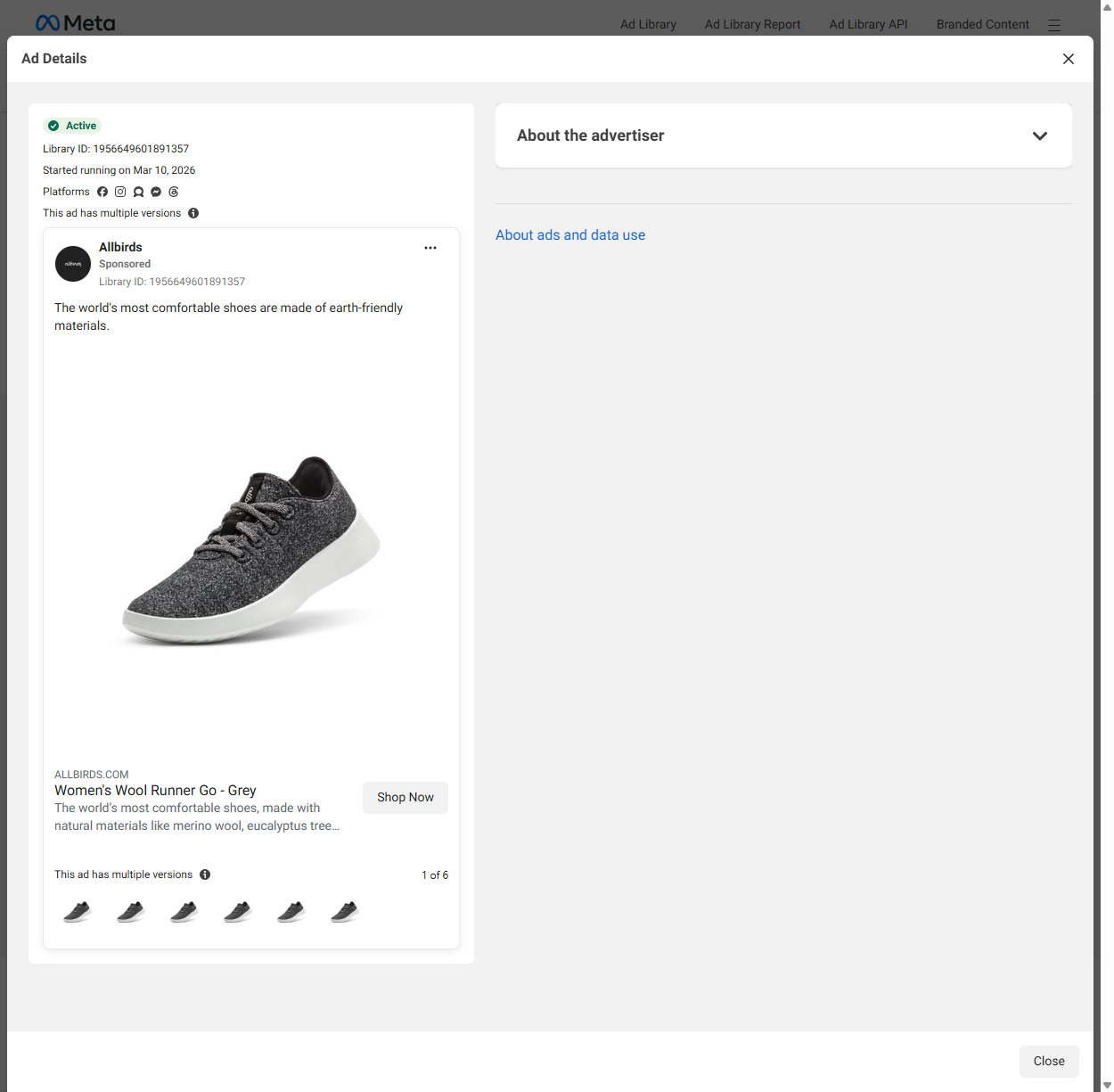
Allbirds' Wool Runner Go ad on Meta is a case study in how sustainable footwear brands compress multiple selling arguments into a single product frame without cluttering the creative. The ad opens with a grey wool shoe centered against a near-white background. There is no lifestyle context, no human foot inside it, no aspirational setting. The shoe floats. The surrounding space communicates confidence: the brand trusts the object enough that it doesn't need narrative scaffolding to hold attention.
The copy reads "The world's most comfortable shoes are made of earth-friendly materials." That sentence does something structurally unusual: it opens with a comfort claim — the most commercially transactional of all footwear attributes — and pivots mid-sentence to an environmental claim, the attribute that earns repeat purchases from values-aligned buyers. "Most comfortable shoes" is unfalsifiable hyperbole every footwear brand uses or something adjacent to. But Allbirds earns credibility for that claim by anchoring the second clause to material specificity: merino wool and eucalyptus tree fiber are named in the expanded body copy. Those materials are measurable, sourceable, and third-party-certified. That's the credibility transfer mechanism — the vague comfort claim borrows conviction from the auditable material claims downstream.
The headline "Women's Wool Runner Go - Grey" reads like a product SKU description. There's no aspirational language, no invitation, no tension-building. This is not an oversight. Allbirds' acquisition funnel has two phases: brand-building, where the comfort-plus-sustainability thesis gets established through longer content, and retargeting, where the job is to close the person who already understands the brand. This is retargeting creative. The clean SKU headline signals to someone mid-consideration: here is the exact product you were looking at. It removes friction without adding noise.
The CTA is "Shop Now" — the most transactional option in Meta's standard CTA inventory. Paired with a warm retargeting audience, the logic holds: someone already familiar with Allbirds doesn't need "Learn More" or "Discover." They need "Shop Now" to execute the decision they've already made. The format-fit decision throughout — product shot, SKU headline, direct CTA — mirrors how premium footwear brands operate at the bottom of the purchase funnel: confidence over explanation, product over narrative, specificity over sentiment.
The six-variant carousel (visible in the thumbnail row as six colorway thumbnails) is a testing efficiency play. Running the same shoe in all colorways as individual ad versions lets the algorithm identify the highest-converting color without requiring separate creative briefs per SKU. Allbirds' brand identity is built on the Wool Runner as a category-defining product, not a design-differentiated one; the color variants therefore share identical headline copy and body copy. The creative investment concentrates in photography. The copy stays locked. That structural coherence — same claim, same format, same CTA across every variant — is what allows Allbirds to scale creative production without diluting the acquisition message.